



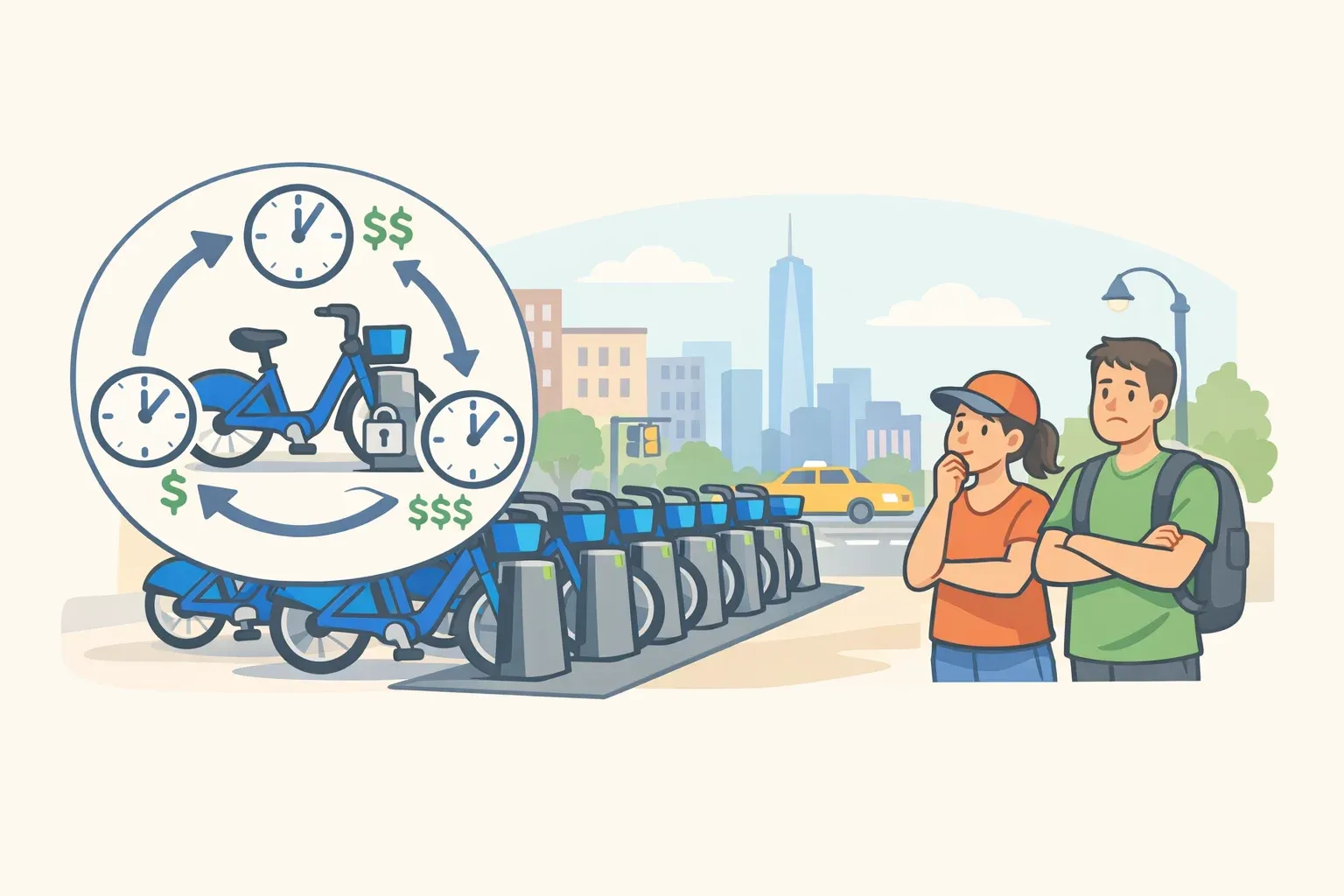
A rumored art installation supposedly slows down Citi Bike rides to reflect New York City's high housing costs. The project is said to use slower rides to make the city's rent crisis feel more visible and immediate.
That failure played out in a literal way on July 23, 2026. By mid-morning, nearly every other dock from Canal Street to the southern tip of Manhattan was full, and commuter Marvin Pichardo spent 30 minutes circling near Laight and Hudson streets with nowhere to leave his bike, paying the 41-cent nonmember per-minute rate the entire time.
The app made it worse: one station listed 18 open spaces that turned out to be occupied by chain-locked, out-of-service bikes, meaning the exact tool riders rely on to avoid overage charges gave them wrong information that morning. The more useful question is whether the current contract protects riders when docking fails like that.
The rider's math: How a full dock becomes an unstoppable bill
Citi Bike's pricing splits into two different systems depending on the bike. Annual members ride classic, non-electric bikes free for the first 45 minutes, then pay 27 cents a minute after that; nonmembers pay 41 cents a minute after just 30 minutes on a classic bike.
E-bikes work differently: members pay 27 cents a minute from the start of the ride, which works out to $12.15 for 45 minutes, while nonmembers pay 41 cents a minute on top of a $4.99 unlock fee. Members who ride e-bikes between Queens or Brooklyn and Manhattan do get a price cap of $5.40 for that specific trip, a rare instance where Citi Bike sets a ceiling on cost. No such cap covers a ride that gets stuck circling for an open dock in Lower Manhattan.
For comparison, a similar 45-minute e-bike trip costs about $1.05 in Tokyo, and $1.35 in London, and Los Angeles's Metro Bike Share gives riders the first 30 minutes free before charging $1.75 per half hour after that. Those are reported fare comparisons rather than matched studies, and membership terms, time increments, and currency conversions may not line up exactly, but the gap between them and New York's rates is wide enough to notice.
During the July shortage, Pichardo's per-minute charge kept running for the entire 30 minutes he spent circling. The reporting does not identify a pause function or grace period that stops the fare while a rider searches for a dock.
Some riders gave up entirely and left their bikes at stations without docking them. What happens to that ride's status, and to whatever charge is still running, goes unaddressed. The reporting simply does not explain how billing or ride status is handled once a bike is left undocked.
One rider offered a theory for why full docks keep happening: "This happens all the time. I feel like they purposefully fill them up so we have to spend longer on them," she told Streetsblog before hurrying off to find parking elsewhere.
That's a suspicion, not a documented finding. The reporting confirms the pattern of full docks and the charge that kept running through the July incident specifically. It doesn't confirm intent, and it doesn't establish that every docking failure across the system plays out the same way.
Pricing has climbed while the system has also become slower at its top assisted speed. In 2025, city transportation officials pushed Lyft to cut the e-bike top speed from 18 mph to 15 mph without ordering a matching price cut.
Citi Bike data showed actual ride speeds fell only about 4%, since most riders travel below the maximum anyway, but the fare increase applied regardless. A fairly ordinary trip from Chambers Street to 125th Street now costs $1.62 more for members and $2.46 more for nonmembers than it did before that speed reduction. Riders are paying more for a capped-speed service, on top of a per-minute fare that keeps running when a docking shortage extends a ride.
Why full docks keep recurring, and what the contract does and doesn't require
The July shortage wasn't an isolated weather fluke. Lyft attributed it to a rainstorm the night before, which threw off the usual flow of bikes into Manhattan in the morning and back out in the evening. The company said crews relocated hundreds of bikes overnight but acknowledged riders still "felt that crunch."
This has happened before. On May 1, 2024, Streetsblog counted only five open docks across all of Manhattan south of Houston Street and east of Bowery, and winter storms earlier this year left much of the system unusable for weeks at a stretch.
The contract's clearest blind spot involves so-called "never die" stations, roughly 10% of the system, which are supposed to avoid sitting completely full or completely empty for more than 3% of operating hours in a given month, between 6 a.m. and midnight. That window leaves overnight hours uncovered entirely. The bigger issue is that the public contract doesn't say which stations carry the "never die" designation at all, so there's no way for riders or reporters to check whether it's being honored.
Enforcement has its own threshold built in. The Department of Transportation cannot fine Lyft until a station has been unusable for four uninterrupted hours, and the penalty is $30 per hour per station after that. A shortage that lasts less than four uninterrupted hours never triggers a fine, no matter how many riders it strands along the way.
The financial backdrop adds another layer. Citi Bike costs more than any comparable bike-share system in the U.S., Canada, or Europe and receives no city subsidy, according to a November Independent Budget Office report cited by Streetsblog, and New York collected only about $4 million in revenue share from Lyft in 2024.
Lyft already runs a different model elsewhere. In Jersey City and Hoboken, riders who arrive at a full station can park next to the dock and confirm it with a photo in the app. That overflow option wasn't available to Citi Bike riders in the five boroughs at the time of Streetsblog's report. Mobility researcher Calvin Thigpen argued the system should be "more permissive and flexible ahead of time" instead of leaving riders to sort it out mid-ride.
None of this proves Lyft is engineering scarcity to collect overage fees. It shows a contract with a high bar for enforcement, an undisclosed list of protected stations, and a fix the company already runs across the Hudson River that hasn't reached New York's own bike-share riders.
What the Citi Bike comparison can and cannot say about New York City's rent crisis
Citi Bike's fees have climbed for five consecutive years. Annual membership costs $239 before any e-bike charges, and a daily e-bike commuter could pay roughly $2,264 a year in fees alone, more than the roughly $1,500 an equivalent annual transit pass would cost over the same stretch.
On the housing side, in 2022, 43% of New York City households were housing cost-burdened under the state's standard of spending more than 30% of income on housing, the highest rate of any region in the state, according to a report the state comptroller's office published in 2024. That figure measures cost burden specifically. It's a separate metric from the same report's findings on severe burden, overcrowding, or homelessness, and this comparison doesn't blend those numbers together.
Both situations turn an institutional shortfall into an unplanned cost. A docking shortage bills a rider in real time for a rebalancing failure that isn't theirs; a tight housing market bills a renter for a supply shortage the city has been slow to close. That's the extent of the parallel that holds up. The duration, the stakes, and who ends up paying are not the same.
It is difficult to know who actually pays Citi Bike's overage fees. A 2023 study found that ridership was higher in wealthier, denser neighborhoods and lower in neighborhoods with larger Black and Hispanic populations. However, the study explained only about a third of the differences in ridership and tracked where trips began, not which riders paid extra because they could not dock a bike.
There is no clear evidence that riders paying these fees are also those most affected by high housing costs. In 2022, 90% of New York renters earning under $35,000 were cost-burdened, compared with 16% of renters earning over $75,000. Overall, 52.4% of renters were cost-burdened, versus 28% of homeowners.
The comparison also breaks down on duration. Pichardo's July docking delay ran about 30 minutes, an unpleasant but finite stretch. Housing cost burden is structurally different, a condition that can persist year after year and, in its more severe forms, extend into eviction, overcrowding, or homelessness, outcomes the comptroller's report tracks as distinct categories with no equivalent in bike-share billing data.
The Citi Bike mechanism is a clear, concrete illustration of how a broken shared system can turn an ordinary delay into a real cost. It isn't evidence that Citi Bike pricing shares a cause with, or illustrates the scale of, New York's housing cost burden.
What the reporting supports, and what riders still don't know
Citi Bike's operating contract comes up for renewal in 2029. That gives the city a defined window to negotiate terms the current contract doesn't require: public disclosure of which stations carry "never die" protection, a shorter enforcement trigger than four uninterrupted hours, and an overflow-parking option like the one Lyft already runs in Jersey City and Hoboken. None of those changes are confirmed, planned, or promised anywhere in current reporting. They're options built on a capability Lyft has already deployed elsewhere in its own network, not commitments the city has made.
On the question that matters most to a rider stuck mid-fee during a docking failure, the record is thin. Lyft declined to say publicly whether it would refund charges riders accrued while searching for a dock during the July shortage. The reporting does not identify a formal dispute process or refund policy for this exact situation, which leaves riders with no clear answer if the same thing happens to them.
A rider stuck in that spot has no guaranteed remedy, but a paper trail still helps: the station name, the time, the ride ID, and a screenshot of the app's listing before the ride ends. Whether that produces a refund depends on Lyft's support team handling it case by case, since no published policy spells out the outcome either way.
The real test to watch for is what the 2029 contract actually requires. It would show up as a documented way for a rider to end or dispute a charge when every dock within reach is unusable, not as an art installation making the point on their behalf.















Comments
Be the first, drop a comment!