



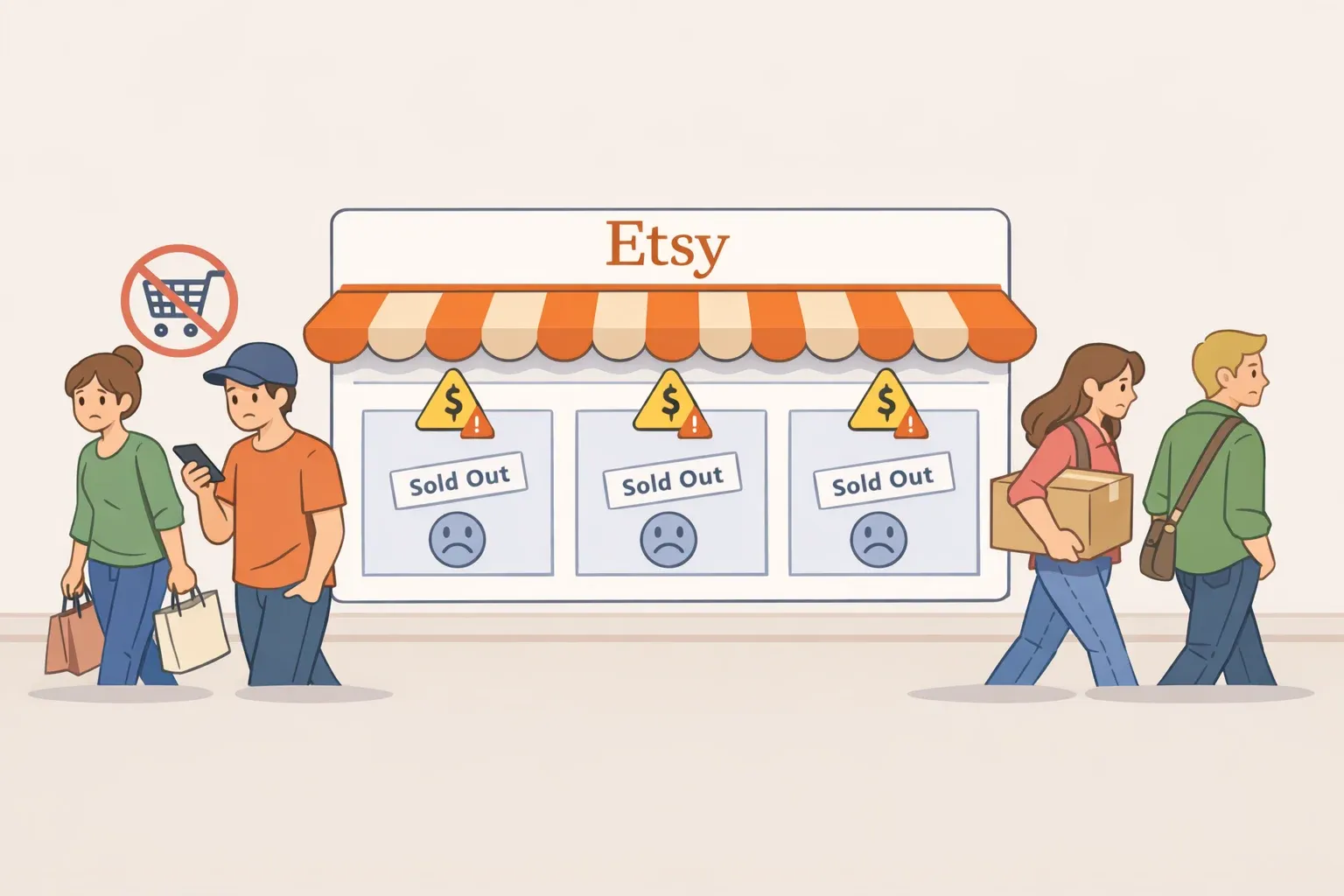
Etsy's marketplace has contracted for two straight years while the broader e-commerce sector grew in both years. That's the headline. The more telling detail: during the same period, Etsy's revenue hit record highs, and its profit margins stayed strong.
For a company whose platform is losing sellers and buyers simultaneously, the financials look surprisingly healthy. Understanding how that gap exists reveals more about Etsy's current trajectory than either number alone.
The story circulating in seller forums focuses on why Etsy sellers are leaving, and that story is real. But it's secondary. Etsy's deeper problem is weakening buyer demand. The company has offset that weakness by extracting more revenue from a smaller, more expensive-to-operate marketplace, a strategy that protects Etsy's financials while quietly making the platform harder for individual sellers to thrive on.
The numbers frame the problem clearly. Gross merchandise sales on the Etsy marketplace fell 6% in 2024 to $10.9 billion, then another 4% in 2025 to $10.5 billion, with performance trailing overall e-commerce growth in both years, per the company's 2024 and 2025 annual filings.
Active buyers fell from 89.6 million in Q4 2024 to 86.5 million in Q4 2025, a 3.4% year-over-year decline. Over that same stretch, Etsy's take rate climbed from 22.8% in Q4 2024 to 24.5% in Q4 2025, meaning sellers kept less of every sale even as overall transaction volume shrank.
What follows traces what happened to sellers and buyers over the past two years, examines how Etsy stayed profitable while its platform stagnated, and draws out what that gap means for anyone deciding whether to sell on Etsy today.
Why Etsy sellers are leaving: the numbers and the contested explanations
The seller count data is stark. The Etsy marketplace closed 2024 with 5.6 million active sellers, down 10% from the prior year. By Q3 2025, the count had slipped further to 5.5 million, a 10.9% year-over-year decline, before recovering slightly to 5.6 million in Q4 2025, with seller retention described as "inflecting positively" in that quarter.
Etsy attributes the bulk of the decline to a setup fee introduced in April 2024, designed to filter out low-commitment sellers. Its 2025 10-K describes the result as "anticipated and intentional," and points to stabilization beginning in Q2 2025 as evidence the policy worked as designed.
The "intentional pruning" explanation is plausible and consistent with the stabilization data. But company filings are self-serving by nature. What the public record cannot establish is whether the setup fee was the primary driver, or whether rising fee structures and long-running seller frustration over cheap mass-produced goods crowding Etsy's listings had already made the platform less attractive to serious handmade sellers before the policy arrived. Those are plausible hypotheses, documented in seller complaints and trade coverage, but not directly established by the data available here.
Both explanations can be true simultaneously. The data shows seller counts fell sharply, then stabilized. It doesn't resolve whether that stabilization reflects genuine quality improvement or simply the departure of sellers most willing and able to leave. The buyer data examined next complicates Etsy's tidy narrative considerably.
The buyer problem is harder to spin
Seller attrition can be reframed as curation. Buyer attrition is harder to dress up.
The demand-side numbers show a consistent pattern: fewer buyers shopping, the buyers who remain spending less, and the sharpest losses concentrated among the most valuable segment.
Spend per active buyer on a trailing twelve-month basis sat at $121 in Q4 2024, down 3.5% year-over-year, and was still $121 in Q3 2025, down 1.6% year-over-year. Flat in dollar terms, eroding in real terms. The 2025 10-K names reversing these trends a prerequisite for any growth, an unusually candid admission for a public filing.
The habitual buyer numbers are worse. Buyers who made six or more purchases in the trailing year numbered 6.4 million in Q4 2024, down 9.5% year-over-year, and slipped further to 6.0 million by Q3 2025. These are the repeat customers who return often and spend more per visit. Their continued decline is a problem no amount of one-time reactivation campaigns can mask.
New buyer acquisition is weakening at the source, too. Etsy added 24 million new marketplace buyers in 2024, a 14% decline from 2023, even as it reactivated nearly 29 million lapsed buyers the same year. The platform is working harder to recycle former customers while finding fewer new ones.
Reactivating 29 million lapsed buyers is a genuine operational achievement. It's also a treadmill. If those reactivated buyers churn back out at the same rate they left before, the active buyer count keeps compressing regardless of the effort. The declining habitual buyer count suggests that's exactly what's happening: Etsy is replenishing the pool while losing its deepest end.
Why buyers are drifting and why Etsy's niche got complicated
The buyer weakness doesn't exist in a vacuum. It reflects a structural mismatch that Etsy largely created for itself, then got caught in when the macro environment shifted against it.
Supply-chain consultant Brittain Ladd told Marketplace early last year that Etsy's problem is straightforward price competition: on Amazon or Temu, comparable goods cost less, and Etsy offers no credible answer at the low end.
He argued the platform has likely peaked. EMARKETER analyst Sky Canaves told the same outlet that Etsy's pivot back toward genuinely artisanal goods, a logical response to brand dilution, likely appeals to a narrower audience, and projected continued sales contraction as a result.
Etsy itself attributed its Q4 2024 marketplace weakness in part to "a highly promotional and competitive retail environment" and pressure on consumer discretionary spending, per its Q4 2024 earnings release, external conditions that make premium-priced handmade goods a tougher sell.
The trap is visible in retrospect. Etsy spent years allowing mass-produced and dropshipped goods to fill its listings, muddying its "Keep Commerce Human" brand promise at precisely the moment that promise needed to be clearest. Price-sensitive buyers discovered the mass-produced options were cheaper on Temu or Amazon. Artisan-focused buyers began questioning whether Etsy's search results still surfaced what they came for.
Tightening standards now is a defensible instinct. But it means accepting a smaller audience while rebuilding trust, and the buyer numbers suggest that rebuilding is still very much in progress. The financial results, paradoxically, don't reflect any of this turbulence.
How Etsy stays profitable while its marketplace shrinks
This is the part that disrupts the "Etsy is dying" framing: the company's finances look nothing like a dying business. What they look like is a business that has learned to extract more from less.
The numbers are worth sitting with. In Q4 2024, Etsy posted record quarterly revenue of $852.2 million, up 1.2% year-over-year, even as consolidated GMS fell 6.8% in the same period. By Q4 2025, revenue had risen further to $881.6 million excluding the divested Reverb business, with adjusted EBITDA of $222.5 million and a 25.2% margin. Revenue up, merchandise volume down. The gap between those two lines is the story.
The mechanism is a rising take rate. Etsy's cut of each transaction climbed from 22.8% in Q4 2024 to 24.9% in Q3 2025 and 24.5% in Q4 2025, through transaction fees, payment processing, and mandatory participation in programs like Offsite Ads. In 2024, Offsite Ads revenue alone offset approximately 31% of the Etsy marketplace's performance marketing spend, a program sellers above a revenue threshold are required to join.
Meanwhile, Etsy bought back $260 million of its own stock in Q4 2024, $120 million in Q3 2025, and $133 million in Q4 2025. Shares outstanding fell from 107 million in early 2025 to 96 million by early 2026.
One clarification matters. Some of Etsy's 2025 year-over-year comparisons are complicated by the June 2025 sale of Reverb, a music gear marketplace. As-reported figures that include Reverb's prior-period contribution look worse than Etsy marketplace-only numbers; the company's filings flag this distinction repeatedly. Strip Reverb out, and Etsy's core marketplace GMS was actually up 2.4% in Q4 2025, modest growth, but not the contraction the headline figures imply.
The coexistence of shrinking GMS and growing revenue doesn't signal a healthy marketplace so much as a platform that has shifted toward monetization outpacing marketplace health. When fewer dollars of merchandise flow through but Etsy collects more per dollar, sellers absorb the difference. That's a workable short-term lever. As a long-term model for a marketplace that depends on a thriving seller base, it raises questions Etsy has not publicly answered.
What this means if you're a seller on Etsy today
Etsy is not collapsing. It is profitable, cash-generative, and still connects tens of millions of buyers to millions of sellers. But the nature of that marketplace has shifted in ways that matter practically, and the shift is still underway.
Buyer momentum is the company's declared central challenge. The 2025 10-K states plainly that reversing declining active buyer counts and per-buyer spend is a prerequisite for growth. Companies don't usually make that kind of admission unless the problem is significant and unresolved.
Seller stabilization in late 2025 is real; the year-over-year decline narrowed to 1.5% by Q4, but it coincides with a higher-cost operating environment: the take rate expansion from 22.8% to 24.5% between Q4 2024 and Q4 2025 means sellers keeping less of each sale on a smaller volume of transactions. New buyer acquisition fell 14% in 2024, per the 2024 10-K, making organic discovery harder for sellers who depend on new customers finding their shops.
Etsy can look healthy to shareholders while becoming a more expensive, lower-traffic channel for individual sellers. That doesn't make it worthless. A platform with 86 million active buyers still offers genuine reach, particularly for sellers with differentiated products that don't compete on price.
What would signal genuine improvement over the coming quarters is worth naming explicitly. Active buyer growth turning positive, even modestly, would be the most meaningful indicator. Recovery in the habitual buyer count would matter more than raw active buyer figures, since those repeat customers drive a disproportionate share of seller revenue.
A take rate that stabilizes rather than continues rising would suggest the platform is investing in growth rather than extracting from it. And sustained seller count stabilization, not just a single quarter of inflection, would indicate that whatever curation the setup fee accomplished has run its course without deterring serious sellers.
None of those signals are clearly visible yet. The era when a new Etsy shop could grow organically on the back of a rising tide of buyers is, at minimum, on pause. Whether it returns depends largely on whether Etsy can fix its demand problem, and the data available gives no clear indication it has found the answer yet.
















Comments
Be the first, drop a comment!