



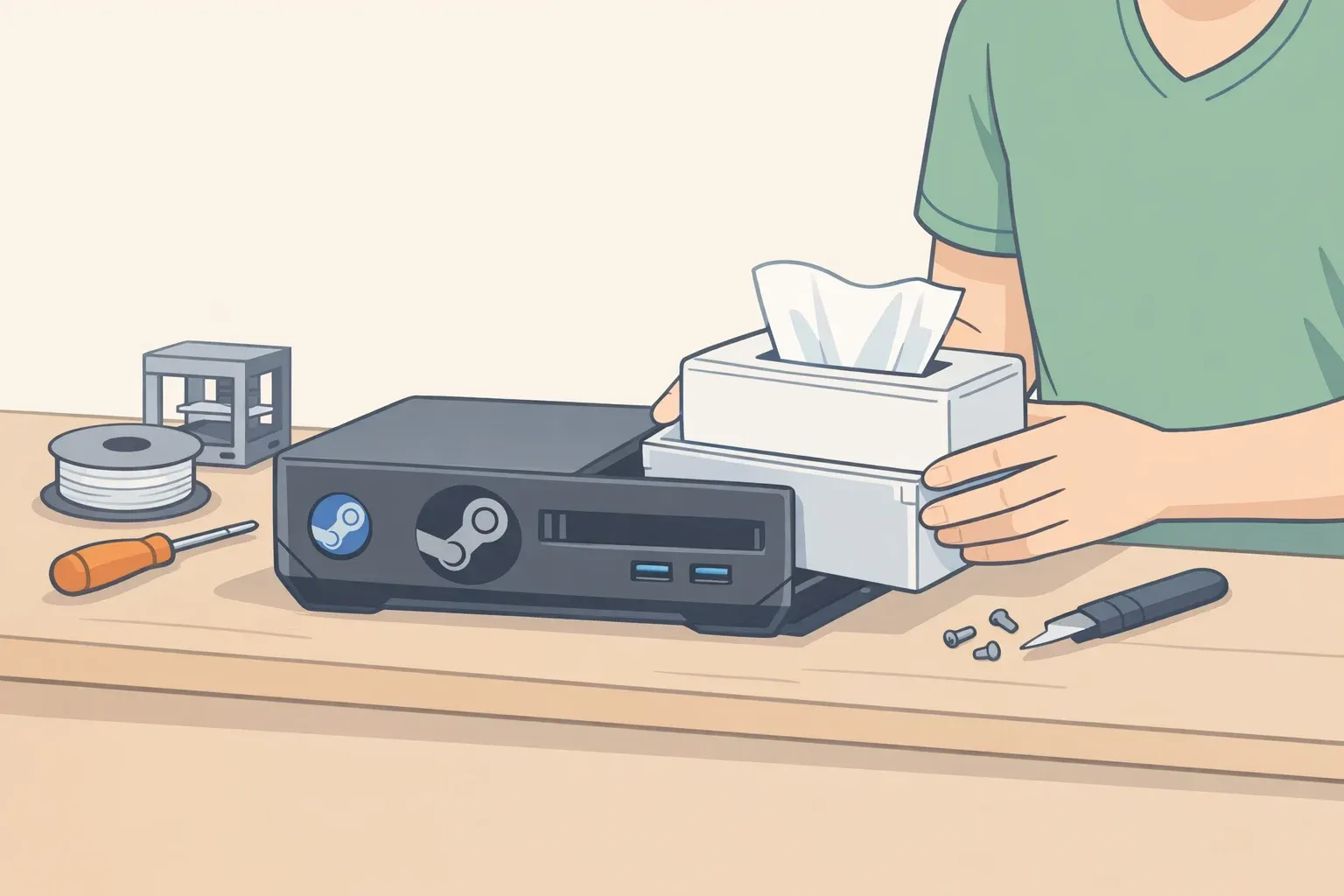
A Reddit user has designed a 3D-printed Steam Machine tissue box that keeps Valve's console-like front fascia intact while hiding a tissue box where the hardware would normally sit. The design, credited to Reddit user itsBoyso, is available now on MakerWorld as print files, listed in 512GB and 2TB versions.
PCWorld's report came 12 days after Valve published the console's exterior shell as a CAD file on a public GitLab repository, telling fans: "Feel free to use these to make your own Front Plates, or whatever else you want to create!" No source confirms itsBoyso actually used that file, and the timing alone doesn't establish a direct link.
This piece covers how the replica is built, what Valve's CAD file actually unlocks for other makers, and how the real console has performed in reviews since it began shipping.
How the 3D-printed Steam Machine tissue box works
itsBoyso built what they call a "1:1" replica, sized so a smaller tissue box slides in through the rear panel while the front fascia stays clean. The motive, in itsBoyso's own words on the Steam Machine subreddit, was plain: "Always liked the look and design of the Steam Machine, but financially, couldn't justify treating myself to one."
The replica also reproduces the console's swappable magnetic faceplate system rather than only copying its outer shape. The print files don't include magnets, though. Builders have to source those on their own.
What Valve's CAD release does and doesn't make possible
Valve committed a STEP model of the Steam Machine's external shell to a public GitLab repository last month. The commit is credited to SteamOS lead Pierre-Loup Griffais, and it sat unremarked for roughly two weeks before Valve mentioned it in a later hardware update.
The repository holds exactly three items: a readme, a license, and one file, steam_machine_3d.stp, covering the surface topology of the shell's exterior. That single file carries mounting-point positions, fan cutouts, foot placement, and the exact contours around the power button and rear I/O.
Those are the specific measurements anyone building a faceplate, bracket, VESA mount, or dust cover would otherwise have to reverse-engineer with a set of calipers, and Hardware Busters described the release as removing that guesswork for the Steam Machine magnetic faceplate mod community.
It's external geometry only. There's no board layout, no cooler design, no indication of how Valve packed the internals. Hardware Busters noted that makers designing exterior accessories don't need any of that data; the shell measurements are the only thing an enclosure project actually requires.
The license terms matter for anyone with commercial ambitions. Valve released the file under a Creative Commons Attribution-NonCommercial-ShareAlike 4.0 license, meaning derivative work has to credit Valve, can't be sold commercially, and must be shared under the same terms if redistributed. Valve's own readme goes further, recommending fabrication be left to professionals and noting that damage from a DIY mod isn't a warranty matter.
The Steam Controller and its wireless Puck accessory received the same treatment in May, according to Hardware Busters. Hardware Busters expected the first printed faceplates to appear within days of the Steam Machine file going public.
Praised design, questioned price
The console the replica imitates has drawn a consistent split across reviews, though not a single shared verdict. PCWorld called the setup shockingly fast, noting games started downloading in under 20 minutes from first power-on, and described the unit itself as "mouse-fart quiet." The same review flagged its $1,049 starting price as hard to justify, putting real-world performance at roughly PS5 level despite the console costing nearly double what a PS5 does.
Tom's Guide put it more bluntly, describing that same $1,049 price as leaving the console "lost in no man's land" between PC and console. TechRadar came close to calling it the "perfect couch-gaming PC" while still doubting whether it's worth the money.
PCWorld praised the compact, quiet design specifically, while WIRED's testing listed the console's physical design among its strengths and found reliable 1080p performance, with occasional 4K in less demanding titles once FSR upscaling was switched on.
WIRED also pointed out that Valve markets the machine as capable of "up to 4K at 120 Hz," even though the Steam Machine Verified label Valve plans to apply to games on the Steam Store is built on 1080p testing, not native 4K. Across a broader range of games, WIRED called the console "almost wholly incapable" of consistent true 4K, high-frame-rate performance.
The tissue box replica keeps the shape these reviewers praised, without the price tag each of them separately questioned.
Before you download the Steam Machine 3D print files
Two practical details matter for anyone building one. The compartment is sized for a smaller tissue box loaded through the rear panel, so measuring before printing is worth doing. The magnets for the swappable faceplate aren't included in the files, either; those have to be sourced separately.
The files sit on MakerWorld under the "512GB" and "2TB" listings PCWorld referenced. Anyone printing, sharing, or selling copies should check the license terms on that listing directly, since Valve's noncommercial restriction on the underlying CAD file doesn't automatically tell you what terms itsBoyso attached to the derivative design.
Beyond this one project, Valve's exterior file appears to be finding other uses. The Steam Controller and Puck now have exterior geometry circulating too, giving modders three products' worth of shell measurements instead of one. Hardware Busters expected printed faceplates to follow within days of the Steam Machine file's release.
What remains unconfirmed is simpler than what's confirmed. The tissue box itself is real, its dimensions and faceplate compatibility are documented, and it's available to print today. Whether itsBoyso built it from Valve's CAD file or measured an actual Steam Machine independently isn't established anywhere in the reporting. Valve's release covers exterior geometry only; nothing about what sits inside the case it's shaped like.
















Comments
Be the first, drop a comment!